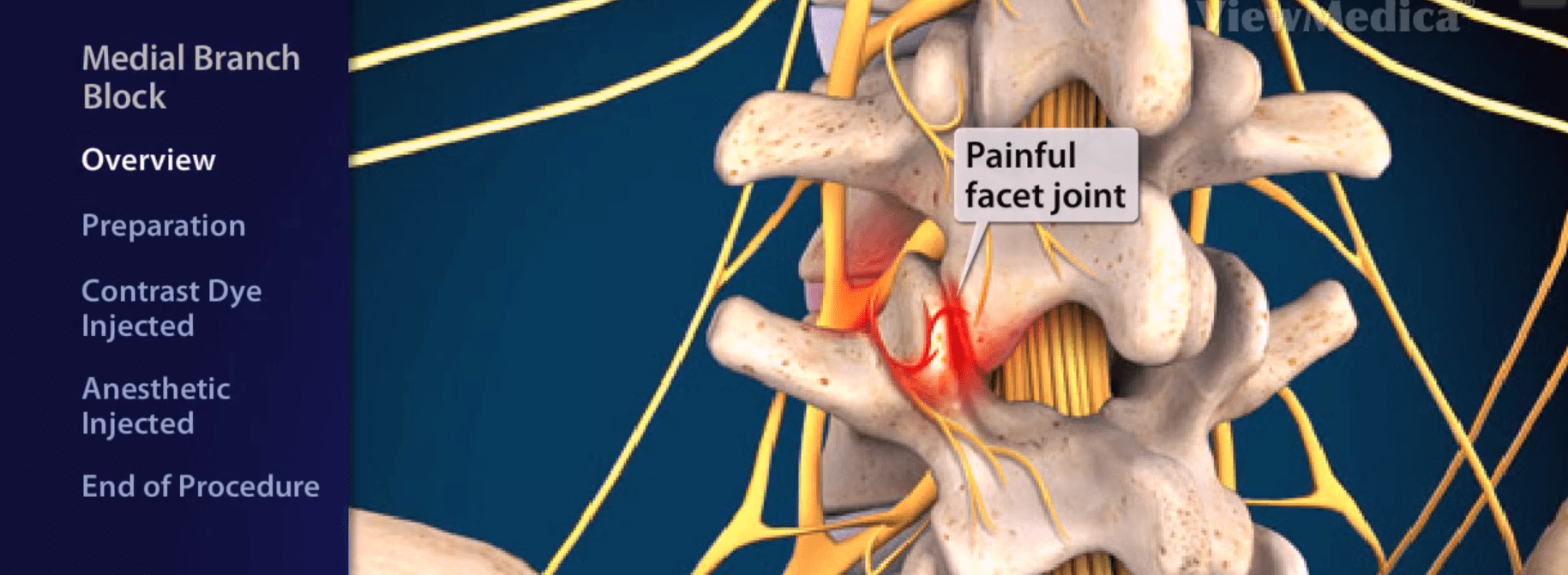
Facet Joint Syndrome / Arthritis

Overview

Facet joint syndrome is an arthritis-like condition of the spine that can be a significant source of back and neck pain.. Medication, physical therapy, joint injections, nerve blocks, and nerve ablations may be used to manage symptoms. Chronic symptoms may require surgery to fuse the joint.

Anatomy of the facet joints

The spine is made of a column of moveable bones called vertebrae that connect to one another. Each vertebra functions as a three-joint complex with a large disc in the front and two facet joints in the back.

What is facet joint syndrome?

Pain that comes from one or more facet joints is called facet joint syndrome or facet arthropathy. Degenerative changes in the spine may cause body weight to shift unevenly to the facet joints

What are the symptoms?

Facet joint degeneration can be painless until an event triggers symptoms. There are several symptoms that indicate a person’s pain is coming from the facet joints. The pain is often a diffuse, dull ache in the low back directly over the spine that can spread to the buttocks. In the neck it can be felt in the shoulders and back of the skull.

What are the causes?

As we get older, cartilage in our joints wears down. An injury, repetitive movements, obesity, poor posture and other spine conditions that change the way the facet joints align and move can cause pain.

Changes in the facet joints can begin with the deterioration of a vertebral disc. As the load of the body weight shifts to the facet joint, the cartilage breaks down, the joint space narrows, and the bones rub together.

Lumber Radiofrequency Ablation

BACKGROUND:

Radiofrequency ablation (RFA), a procedure using heat to interrupt pain signals in spinal nerves, is an emerging treatment option for chronic low back pain. Its clinical efficacy has not yet been established.

OBJECTIVE:

To determine the efficacy of RFA for chronic low back pain associated with lumbar facet joints, sacroiliac joints, discogenic low back pain and the coccyx.

METHODS:

A systematic review was conducted. Medline, EMBASE, PubMed, SPORTDiscus, CINAHL and the Cochrane Library were searched up to August 2013. Abstracts and full-text articles were reviewed in duplicate.

Included articles were sham-controlled randomized controlled trials (RCTs), assessed the efficacy of RFA, reported at least one month of follow-up and included participants who had experienced back pain for at least three months.

RESULTS:

The present systematic review retrieved 1063 abstracts. Eleven sham-controlled RCTs were included: three studies involving discogenic back pain; six studies involving lumbar facet joint pain; and two studies involving sacroiliac joint pain. No studies were identified assessing the coccyx.

The evidence supports RFA as an efficacious treatment for lumbar facet joint and sacroiliac joint pain, with five of six and both of the RCTs demonstrating statistically significant pain reductions, respectively. The evidence supporting RFA for the treatment of discogenic pain is mixed.

CONCLUSIONS:

While the majority of the studies focusing on lumbar facet joints and sacroiliac joints suggest that RFA significantly reduces pain in short-term follow-up, the evidence base for discogenic low back pain is mixed. There is no RCT evidence for RFA for the coccyx. Future studies should examine the clinical significance of the achieved pain reduction and the long-term efficacy of RFA.

Treatment Options lumbar facet joint

Conservative Treatment

Once a diagnosis of facet joint syndrome has been confirmed, your doctor will likely recommend physical therapy to treat your symptoms. A well-rounded rehabilitation program assists in calming pain and inflammation, improving your mobility and strength, and helping you do your daily activities with greater ease and ability.

Physical therapy may also include the use of ice to decrease blood flow to the affected area and reduce swelling.

Spinal Injection

An injection into your facet joint using cortisone can be helpful for calming pain and inflammation. The injection usually gives temporary relief for several weeks or months.

Surgical Treatment

Surgery may become an option if all conservative methods of treatment fail. Surgery on the facet joint usually consists of a fusion of the joint (also called an “arthrodesis”). To join the two vertebrae together, the doctor will usually insert several metal screws across the joint. Bone graft may also be placed around the joint to help fuse it. The bone graft is usually removed from your pelvic bone right beside the SI joint.

What happens during treatment of Radiofrequency ablation for pain?

At the time of the procedure, you will be asked to sign consent forms, list medications you are presently taking, and if you have any allergies to medication. The brief procedure may last 15-45 minutes, followed by a recovery period.

Step 1: prepare the patient

The patient lies on an x-ray table. Local anesthetic is used to numb the treatment area. The patient experiences minimal discomfort throughout the procedure. The patient remains awake and aware during the procedure to provide feedback to the physician.

A low dose sedative, such as Valium or Versed, is usually the only medication given for this procedure.

Step 2: insert the needle

The technique for nerve ablation is similar to that used for diagnostic blocks. With the aid of a fluoroscope (a special x-ray), the doctor directs a thin hollow needle into the region responsible for the pain. Some discomfort occurs, but patients typically feel more pressure than pain.

Step 3: Deliver heating current

Once the needle is in place, the patient receives a numbing medication. Then a radiofrequency current is passed through the hollow needle to create a small and precise burn, called a lesion, about the size of a cotton swab tip.

The current destroys the portion of the nerve that transmits pain and disrupts the pain-producing signal. The burn takes approximately 90 seconds for each site, and multiple nerves can be burned at the same time.

Symptoms of Arm Pain

Neck pain is a common complaint. Neck muscles can be strained from poor posture — whether it’s leaning over your computer or hunching over your workbench. Osteoarthritis also is a common cause of neck pain.

Rarely, neck pain can be a symptom of a more serious problem. Seek medical care if your neck pain is accompanied by numbness or loss of strength in your arms or hands or if you have shooting pain into your shoulder or down your arm.

Symptoms

Signs and symptoms include:

  • Pain that’s often worsened by holding your head in one place for long periods, such as when driving or working at a computer
  • Muscle tightness and spasms
  • Decreased ability to move your head
  • Headache

What are the benefits vs. risks of Thoracic Facet Injection?

Benefits

  • Pain relief is the primary benefit. You may be anxious about the exposure to X-rays during this test. Please note:
    • No radiation remains in a patient’s body after an x-ray examination.
    • X-rays usually have no side effects in the diagnostic range.

Risks

  • Any procedure where the skin is penetrated carries a risk of infection. The chance of infection requiring antibiotic treatment appears to be less than one in 1,000.
  • Allergic reactions to the contrast material, steroid or local anesthetic may occur. Life threatening or severe allergies are rare.
  • Bleeding is a rare complication that is more common for patients with underlying bleeding disorders or in patients taking blood thinners.
  • Nerve or spinal cord damage or paralysis are rare but can occur as a result of trauma from the needle or infection.
  • Women should always inform their physician or x-ray technologist if there is any possibility that they are pregnant. See the Safety page for more information about pregnancy and x-rays.

Thoracic Facet INJECTION, Texas

WHAT IS A THORACIC FACET INJECTION, TEXAS?

The facet joint is a thumbnail-size joint that is located in pairs between each bone of your spine. Lumbar facet INJECTION, Texas  is a procedure to diagnose or treat back pain from the facet joints. Anesthetic and steroid medications are injected into the joint. To ensure proper placement of the medication the procedure is done under fluoroscopy (a type of low dose X-ray).

WHAT IS THE PURPOSE OF A THORACIC FACET INJECTION, TEXAS ?

Facet joints can become painful and inflamed due to injury, arthritis, or other conditions. Steroid medication can reduce inflammation and pain.

HOW IS THE PROCEDURE PERFORMED?

After you check-in, you will be asked to put on a hospital gown and then lie on a stretcher in the holding room. A brief pre-procedure history will be taken and you will then be transported to the procedure room where you will be positioned on the X-ray table.

After being positioned on the X-ray table, your skin will be cleaned with sterile soap. Anesthetic is injected to numb your skin and muscles over the spine. After this, fluoroscopy (X-ray) is used to guide a needle into the proper location, contrast dye is administered and then medication is slowly injected.

WHAT ARE THE RISKS ASSOCIATED WITH A THORACIC FACET INJECTION, TEXAS ?

Every medical procedure, no matter how small, contains some risks. Anytime a needle is placed into your body there is a risk of tissue injury, infection, and bleeding. If this occurs in or near the spine it can result in nerve damage.

Although extremely rare, severe nerve damage and death have occurred following spine INJECTION, Texas s. INJECTION, Texas s near the spine also risk dural puncture and spinal headache. More common risks include a temporary increase in pain, local tenderness after the INJECTION, Texas , allergic reaction to medication, and side effects from steroids.

Thoracic medial branch block, Texas Southlake, Texas

Objective

Chronic neck or back pain, Texas can be managed with various procedures. Although these procedures are usually well-tolerated, a variety of side effects have been reported. In this study we reviewed cases of unexpected temporary adverse events after blocks and suggest possible causes.

Methods

We reviewed the records of patients treated with spinal pain blocks between December 2009 and January 2011. The types of blocks performed were medial branch blocks, Texas interlaminar epidural blocks and transforaminal epidural blocks.

Results

There were 704 procedures in 613 patients. Ten patients had 12 transient neurologic events. Nine patients were in Group A and one was in Group B. Transient complications occurred in four patients after cervical block and in eight patients after lumbar block.

Side effects of lumbar spine blocks were associated with the concentration of mepivacaine (p<0.05.

Conclusion

Spinal pain blocks are a good option for relieving pain, but clinicians should always keep in mind the potential for development of inevitable complications.

Careful history-taking, appropriate selection of the anesthetics, and using real-time fluoroscopy could help reduce the occurrence of adverse events.

Overview of the cervical or thoracic medial branch block, Texas procedure

Here’s what to expect during a cervical medial branch block, Texas procedure:

  • A nurse will place an IV line for safety purposes.
  • You will lie face down on a table, with two pillows under your chest and a small pillow under your forehead.
  • The injection area is cleaned and numbed before the injection.
  • Using fluoroscopic (X-ray) guidance, your physician will determine the appropriate path for the needle.
  • Your doctor will insert a thin needle to the appropriate area(s) for the block.
  • Next, your doctor will inject a small amount of contrast dye to make sure that the medication will flow exactly where intended.
  • Then, your physician will inject a small amount of long-acting anesthetic.
  • After the procedure, you’ll spend about 30 minutes in the recovery area

Symptoms of Facet Joint Problems, Texas

A correct diagnosis must await subsidence of the acute problem. Symptoms may include the following:

  • Acute episodes of lumbar and cervical facet joint pain are typically intermittent, generally unpredictable, and occur a few times per month or per year.
  • Most patients will have a persisting point tenderness overlying the inflamed facet joints and some degree of loss in the spinal muscle flexibility (called guarding).
  • Typically, there will be more discomfort while leaning backward than while leaning forward.
  • Low back pain from the facet joints often radiates down into the buttocks and down the back of the upper leg. The pain is rarely present in the front of the leg, or rarely radiates below the knee or into the foot, as pain from a disc herniation often does.
  • Similarly, cervical Facet Joint Problems, Texas may radiate pain locally or into the shoulders or upper back, and rarely radiate in the front or down an arm or into the fingers as a herniated disc might.
Design a site like this with WordPress.com
Get started